
Non-living Things
🎯 What I Will Learn
- What is diversity?
- What is classification?
- How can we show classification?
- What are living and non-living things?
- What do living things need to stay alive?
- What are some other characteristics of living things?
- There are many things around us. Some are living things. Others are non-living things.
- Diversity refers to the great variety of living things and non-living things around us.
- We classify the diversity of things around us to understand them better.
- Putting things into groups is called classification.
- We can classify things based on their features, also known as characteristics. Examples: size, shape and colour.
- Things with similar characteristics are placed in the same group.
- The same things can be classified in many different ways.
E.g. A bird and a bee both have wings. This is a similarity.
E.g. A bird has two legs, but a bee has six legs. This is a difference.
- Classification helps us understand and study the diversity of things around us better.
- Classification helps us organise things and show their similarities and differences clearly.
- We can show classification in different ways: using pictures, tables or graphic organisers.
| Animals with no legs | Animals with two legs | Animals with four legs |
|---|---|---|
| Snake | Ostrich | Elephant |
| Fish | Penguin | Cat |
- A flow chart is a common graphic organiser.
- In a flow chart, each ◇ diamond shape has a Yes/No question. The answers help us classify things.
- If the question says ‘Based on the flow chart’, use only the information from the flow chart. Do not use outside knowledge.
- Example: If asked for a similarity between elephant and ostrich based on the flow chart above, the answer is “Both have legs” — not “Both are animals” (not shown in the chart).
- To check your answer: write the names into the flow chart and trace through each question.
- No → P
- Yes → Can it fly?
- No → Q
- Yes → R
Which best represents P, Q and R from: Crow, Grass, Snail?
P cannot move → Grass (plants cannot move from place to place).
Q can move but cannot fly → Snail.
R can move and can fly → Crow.
Answer: P = Grass, Q = Snail, R = Crow → Option (3)
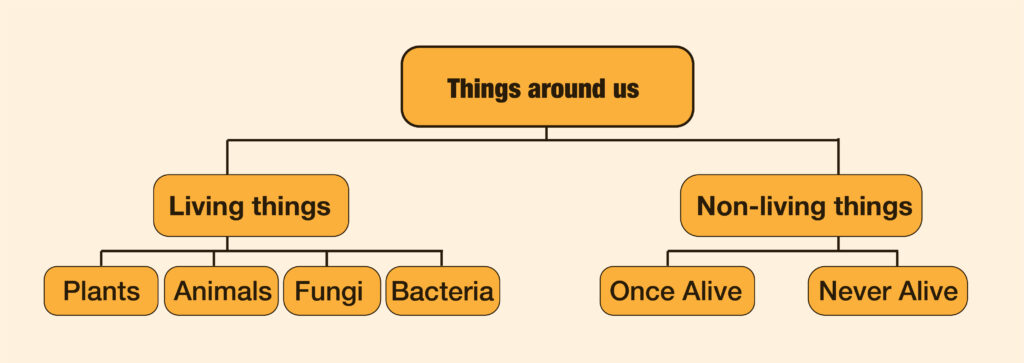
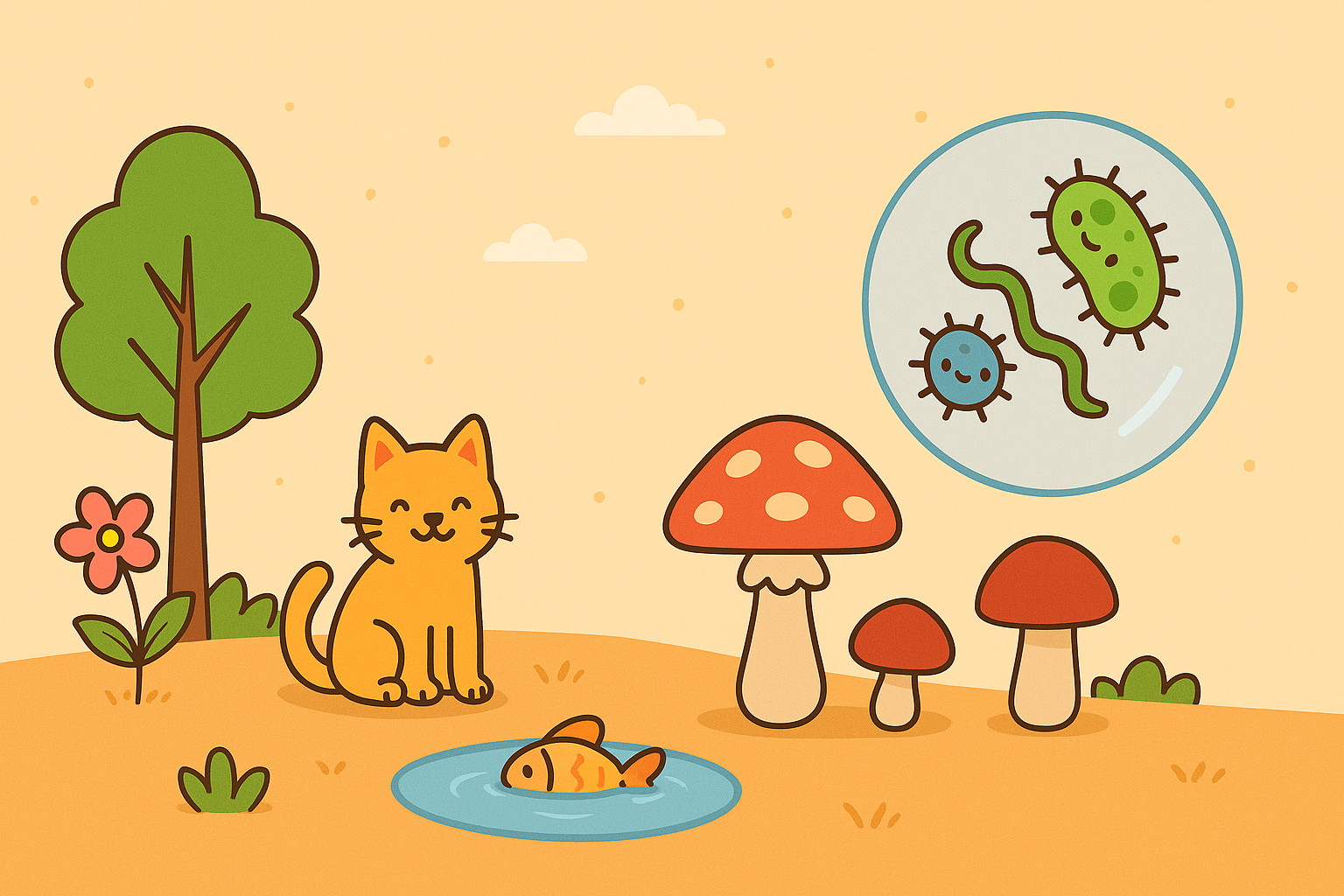
- We can classify things around us into living things and non-living things.
- Living things are things that are alive. (e.g. tree, cat, human)
- Non-living things are things that are not alive. (e.g. cup, clock, chair)
- Living things and non-living things are found all around us.
- Some objects contain both — e.g. a potted plant: the plant (living) sits in a pot (non-living).
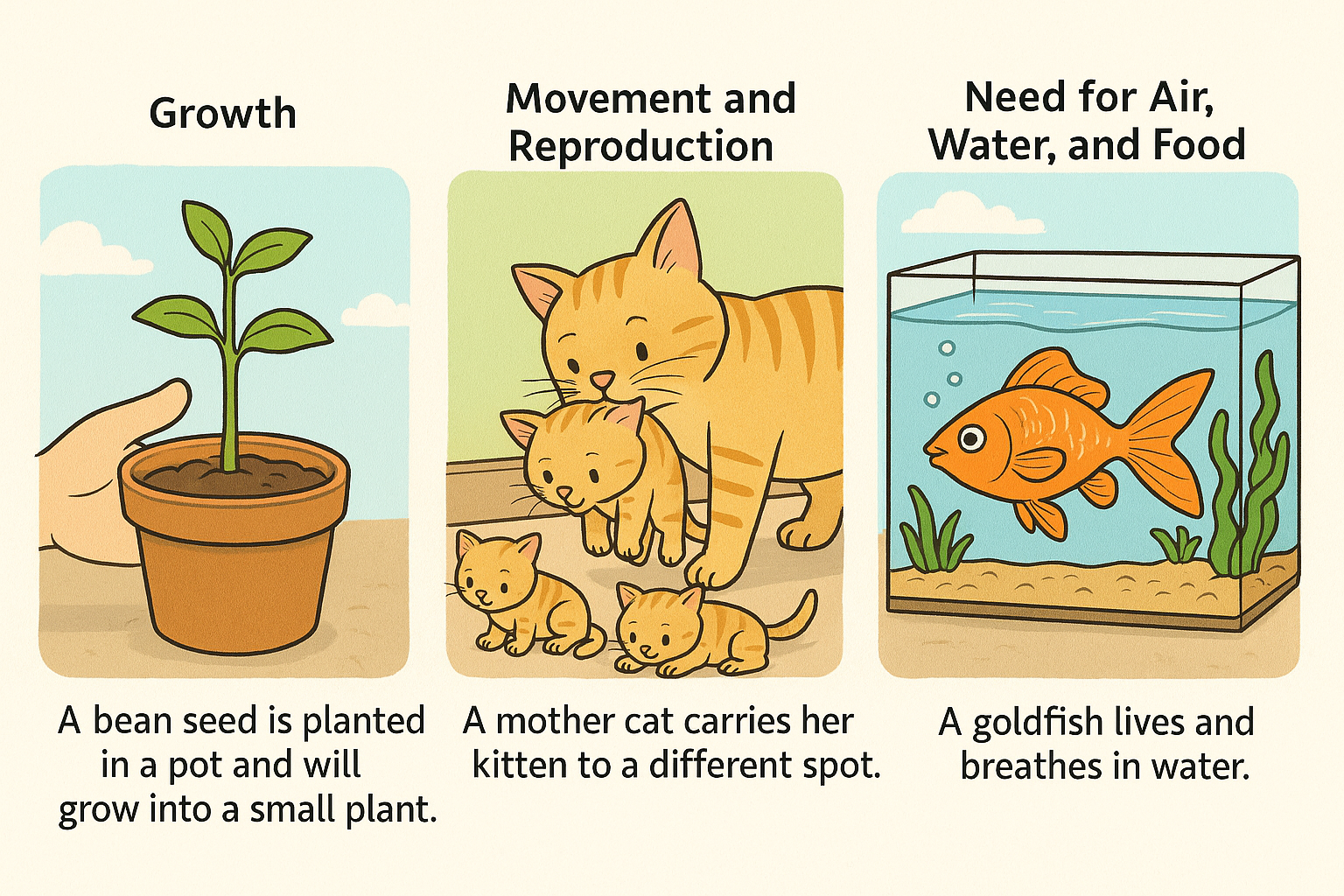
- Living things need air, water and food to stay alive.
- If living things do not have air, water or food, they will die.
- Living things need air to stay alive. Air contains oxygen.
- Animals that live on land breathe in air from their surroundings.
- Animals that live in water have special body parts to help them get air (e.g. fish use gills).
- Plants also need air to stay alive.
- Living things need water to stay alive.
- We need water to digest food, remove waste from our body and carry out daily activities.
- Plants need water to make food. Without water, plants will die.
- Living things need food to stay alive.
- Food gives living things energy. Food also helps living things grow.
- Animals eat food.
- Plants do not eat food. They make their own food when they get air, water and light.
- Set-up A: Water in bowl + leaves + lid with holes
- Set-up B: Water + leaves + lid without holes (no air)
- Set-up C: Leaves only + lid without holes (no air, no water)
- Set-up D: Water + lid with holes (no food)
Q: In which set-up will the grasshopper still be alive after one week?
Set-up A has water, food (leaves) and air (holes in lid). The grasshopper is a living thing — it needs all three to stay alive.
- Living things have many characteristics. Some make them different from non-living things.
- Living things can grow. They become bigger in size.
- Living things also become more complex as they grow — they may develop new body parts. (e.g. tadpole grows legs as it becomes a frog)
- Animals use the food they eat to grow. Plants use the food they make to grow.
- Living things can respond to changes around them.
- Examples of animals responding: A millipede curls up when touched. A boy covers his ears when music is loud.
- Plants also respond: plants bend towards sunlight to make food. The mimosa plant (touch-me-not) closes its leaves when touched.
- Living things can reproduce — this means they can have young.
- Living things reproduce to ensure the survival of their kind.
- If living things do not reproduce, they would become extinct (no more of their kind).
- Some animals reproduce by giving birth (e.g. cats, dogs). Some reproduce by laying eggs (e.g. chickens, fish, frogs).
- Some plants reproduce through seeds. Some reproduce through spores.
| Living Things ✔ | Non-living Things ✗ |
|---|---|
| ✔Need air, water and food | ✗Do not need air, water and food |
| ✔Grow | ✗Do not grow |
| ✔Respond to changes | ✗Do not respond to changes |
| ✔Reproduce | ✗Do not reproduce |
Question: A pangolin curls into a ball when attacked. Which characteristic of living things does this show?
✗ Do NOT say: “A pangolin responds to changes.”
✓ Correct: “Living things can respond to changes.”
Follow the phrasing in the question exactly.
2. Living things can grow.
3. Living things can respond to changes.
4. Living things can reproduce.
⚡ Chapter Summary
- Diversity = great variety of living and non-living things around us.
- Classification = putting things into groups based on characteristics.
- Classification can be shown using pictures, tables, and flow charts.
- Living things are alive; non-living things are not alive.
- Living things need air, water and food to stay alive.
- Living things can grow, respond to changes, and reproduce.
- Mnemonic: Ned’s Grandma Repairs Rockets! (N-G-R-R)
✏️ Test Yourself
(a) Which characteristic of living things did the cat show?
• Living things need air, water and food to stay alive.
• Living things can respond to changes.
• Living things can reproduce.
15 questions · Instant feedback · Scores tracked by topic
A) Living Things
B) Classification of Living Things
Classification of living things
Plants
Animals
Fungi
Bacteria
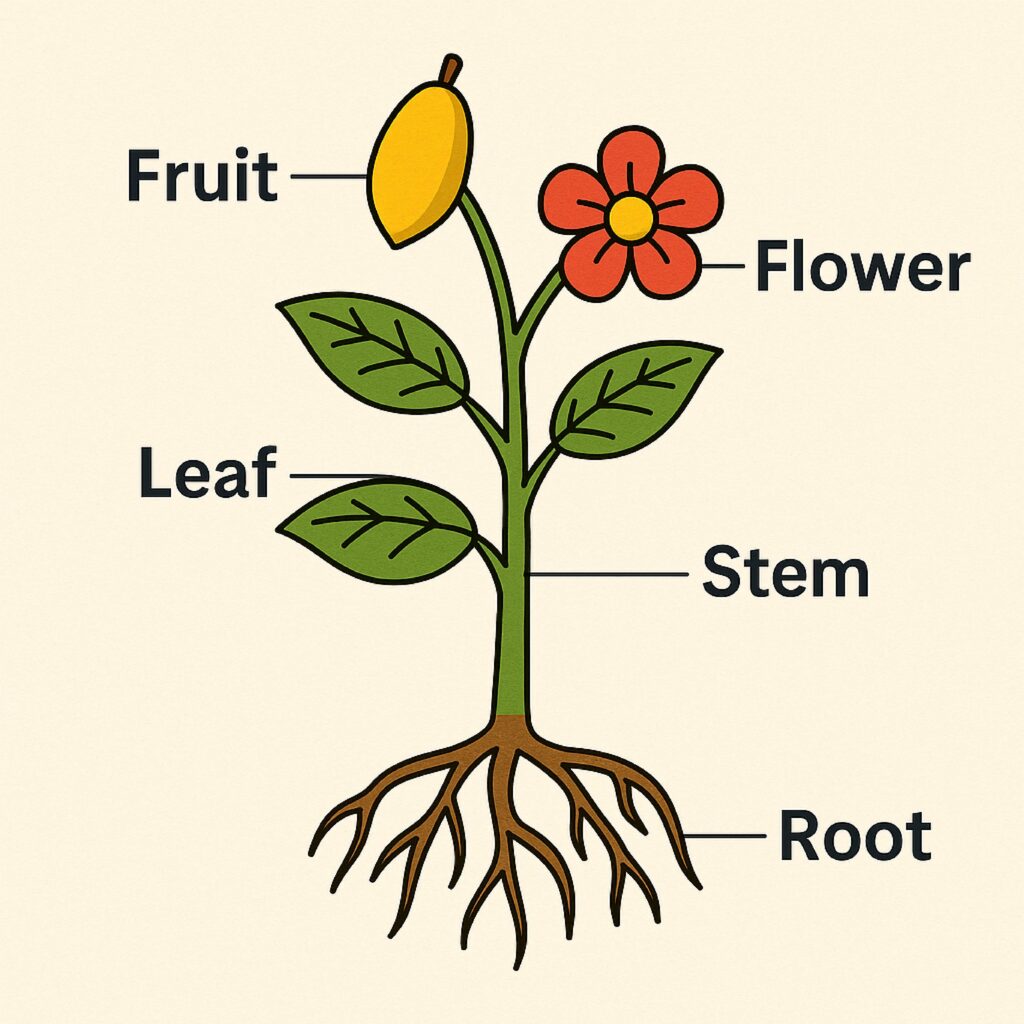
C) Classification of Plants
D) Classification of Animals
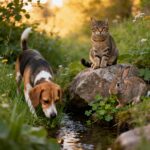
Mammals
– Have hair or fur on their bodies
– Give birth to live young with exception of platypus and spiny anteater
– Have babies that feed on the mother’s milk
– Breathe in air through lungs
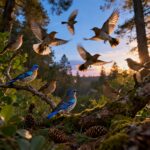
Birds
– Have feathers on their bodies
– Have a beak , pair of wings and a pair of legs
– Lay eggs
– Breathe in air through lungs
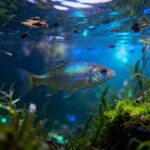
Fish
– Have scales on their bodies
– Live in water
– Have fins for swimming
– Breathe through their gills in water
– Most lay eggs
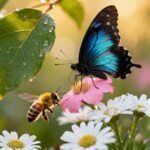
Insects
– Have an external skeleton
– Have 6 legs and 2 antennae
– Hove bodies divided into 3 parts: the head,
thorax and abdomen
– Lay eggs
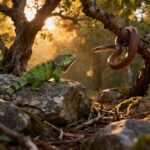
Reptiles
– Have scales on their bodies
– Breathe in air through lungs
– Most lay eggs
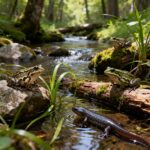
Amphibians
– Have outer coverings of moist skin
– Can live on land and in water
– Lay eggs
– Breathe through moist skin in water and through lungs on land
E) Fungi
Fungi – Key Facts at a Glance
Moulds and mushrooms are living things that help break down dead matter.
F) Bacteria
Bacteria – Tiny Helpers and Harmers
Microscopic living things found almost everywhere around us.
C) Classification of Non-Living Things
Once Alive
never alive
Occur Naturally
Man-made
Occur naturally
Man-made