Water and the water cycle

1. The Three States of Water

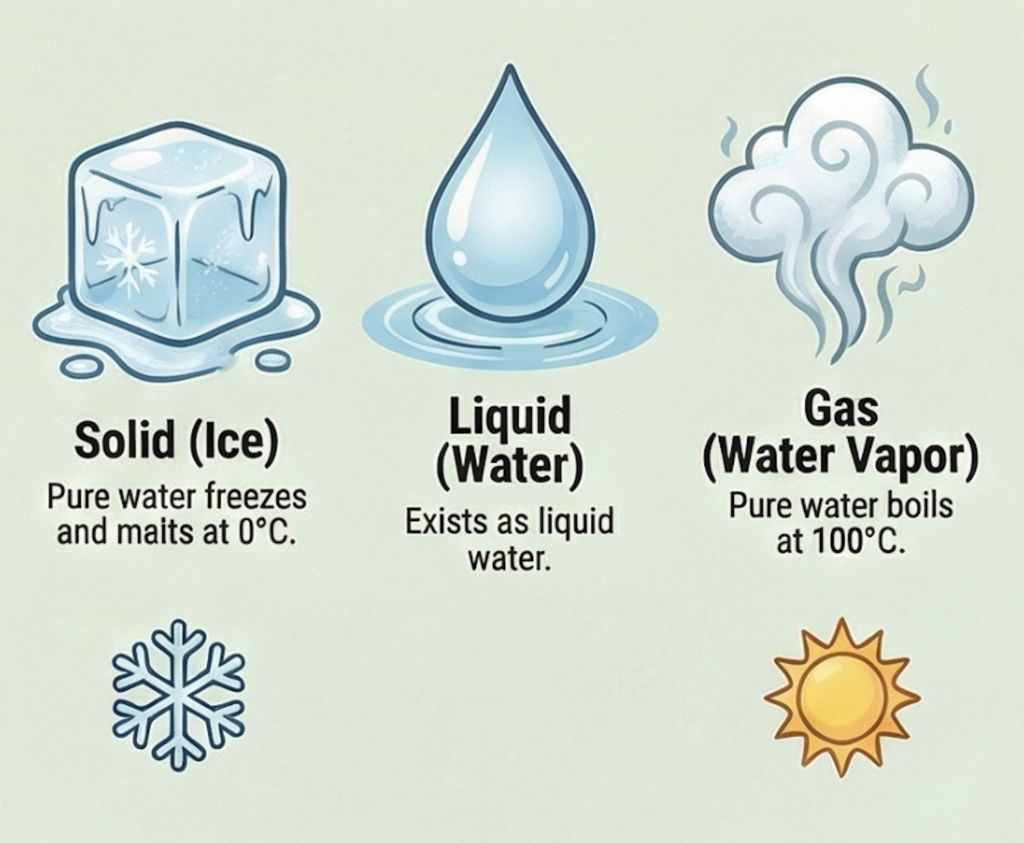
Water is unique because it exists naturally in three states on Earth:

  • Solid Ice, snow, and hail.
  • Liquid Rain, clouds, and tap water.
  • Gaseous Steam and invisible water vapour.

Critical Temperature Points

Water changes state when it gains or loses heat. For pure water, these changes happen at fixed temperatures:

Freezing Point: Pure water freezes at 0°C.
Melting Point: Pure ice melts at 0°C.
Boiling Point: Pure water boils at 100°C.

The “Constant Temperature” Rule

This is a favorite topic in PSLE exams! Remember these two rules:

  1. During Melting: As ice melts, the temperature remains at 0°C. It will not increase until every bit of ice has turned into water.
  2. During Boiling: As water boils, the temperature remains at 100°C. It will not increase until all the water has become steam.
2. Evaporation vs. Boiling

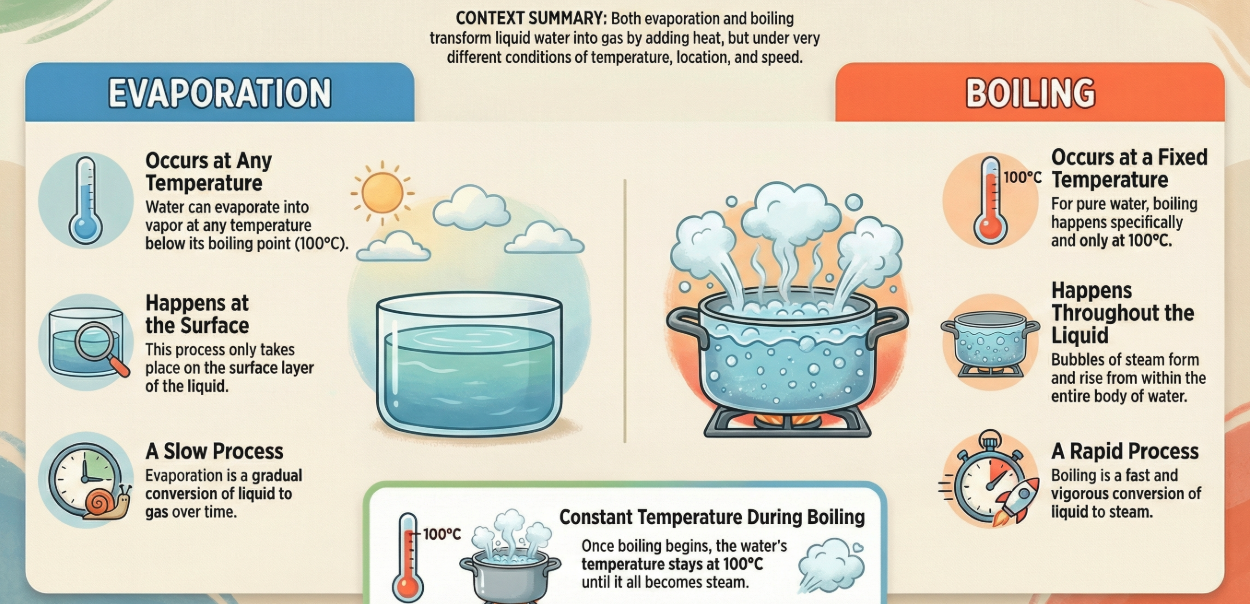
While both processes turn liquid water into a gas (water vapour or steam), they are very different in how they happen.
Feature Evaporation Boiling
Temperature Takes place at any temperature below 100°C. Takes place at a fixed temperature (100°C).
Location Only happens at the water surface. Takes place throughout the entire liquid.
Speed A slow process. A fast process.

3. Factors Affecting Evaporation

How fast water disappears depends on the environment. There are four factors that speed up or slow down evaporation:

🌡️ Temperature Higher temperatures provide more heat, causing water to evaporate faster.
🌊 Exposed Surface Area A larger surface area allows more water molecules to escape into the air at once.
💨 Strength of Wind Stronger winds carry water vapour away from the surface quickly, increasing the rate.
💧 Humidity When air is humid (full of water vapour), there is less “space” for more vapour, so evaporation slows down.

The “Cooling Effect”

Did you know evaporation removes heat? This is why you feel cold when you step out of a swimming pool. The water on your skin absorbs your body heat to evaporate!

4. Condensation in Daily Life

Condensation is the “opposite” of evaporation. It is how water vapour turns back into liquid water.

Water Vapour (Gas) ➔ Loses Heat to Cold Surface ➔ Water Droplets (Liquid)

Where do we see this?

👓 Misty Glasses When you step out of a cold car or bus, your glasses fog up because warm water vapour in the air loses heat to your cold lenses.
🌱 Jungle Orchids Some plants have roots in the air. They survive by letting water vapour condense on their cool root surfaces to “drink” the droplets.
🥤 Cold Drink Cans Have you seen “sweat” on a cold soda can? That isn’t the drink leaking out; it’s water vapour from the air turning into liquid on the cold surface.
🥬 Plastic Bags If you put fresh vegetables in a sealed bag, droplets form inside. The vapour from the leaves loses heat to the bag’s inner surface.

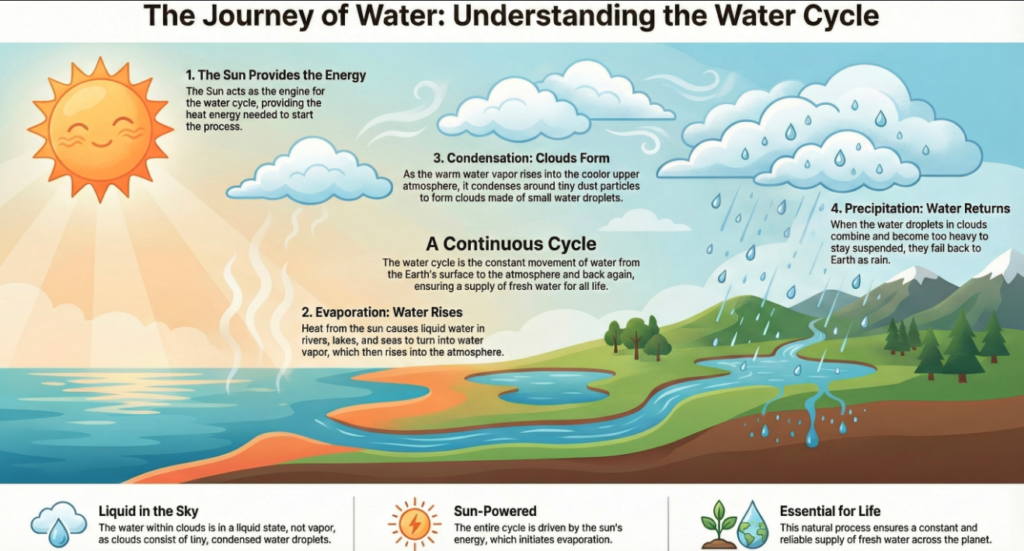
5. The Water Cycle

6. Importance & Conservation

Why Water Matters

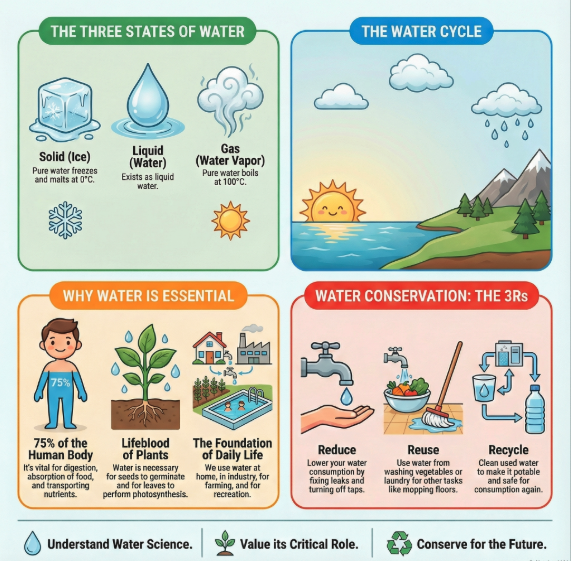
Every living thing needs water to survive. In humans, it makes up 75% of our body and helps transport oxygen and food through our blood. In plants, it is the “transport medium” for minerals and is essential for Photosynthesis.

The 3Rs of Conservation

Since fresh water is limited, we must use the 3Rs to protect our supply:

REDUCE

Use less water.
Example: Turning off the tap while soaping.

REUSE

Use water twice.
Example: Watering plants with rice-washing water.

RECYCLE

Treat dirty water.
Example: Singapore’s NEWater process.

⚠️ Beware of Water Pollution: Litter Oil Spills Agricultural Waste harm our water resources and living things.
Summary

Key Revision Cards

Fixed Points

Tap to flip

Pure water freezes at 0°C and pure ice melts at 0°C. Pure water boils at 100°C.

Change of State Rule

Tap to flip

Temperature remains constant during melting and boiling until the change of state is complete.

Evaporation vs Boiling

Tap to flip

Evaporation: Any temp, surface only.
Boiling: Fixed temp (100°C), throughout liquid.

State of Clouds

Tap to flip

Clouds are in the liquid state. They consist of tiny water droplets formed by condensation.

Sort the 3Rs of Water Conservation

Use a mug to brush teeth
Water plants with rice water
NEWater process
Install low-flush toilets
Mop floor with laundry water
REDUCE
REUSE
RECYCLE

Evaporation: Fast or Slow?

Drag each condition into the correct result box.

Hot sunny day
High humidity
Strong wind
Spread out clothes
Narrow glass opening
FASTER EVAPORATION
SLOWER EVAPORATION

Water Cycle Mastery Test

Top Score: 0 / 20
Final Score: 0 / 20

Scroll to Top